Seawater Property Changes In The Southern Ocean Journals

Journals

May 13, 2011 Videos from the cruise

I was unable to upload the videos I was making through out the cruise because we did not have live internet and had bandwidth restrictions. I will go back and add the videos to the journal where they fit. I am creating this media entry so you can find all videos and do not have to go searching for them in the past entries. Hydrographic sampling I consider this the 'every day video'. It shows the steps taken in most of the 140 rosette casts of the cruise, that happened at night as much as during the day. Begins with the preparation of the rosette by 'caping it', which includes opening the caps, closing the valves and spigots, removing of the ADCP cable, cleaning the sensor of the fluorometer and removing the fresh water syringes from the CTD sensors. You can see a scientists tripping one...

April 27, 2011 Is it over?

The Journey I am at Dallas-Fort Worth airport three hours from seeing my family. It is already hard to believe I was here 78 days ago full of illusion and expectation for the trip to come. The experience, which fulfilled those expectations, is now over, but it will take me a lot of time to assimilate all that I lived. While waiting for our first plane in our long journey back to our normal lives at Punta Arenas' airport, Kevin asked me yesterday for one or two trip highlights. I said being in such remote area of the world with scientific experts, and free to explore the science around me was the highlight. His face showed some disappointment by my answer; he wanted something more specific. I still cannot think of the most amazing moment alone. Perhaps as time molds and archives the...

April 25, 2011 Punta Arenas

Strait of Magellan
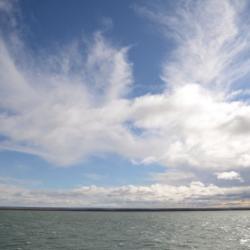
Our time aboard the Palmer has come to an end when we arrived in Punta Arenas, Chile, after an uneventful sailing across the Strait of Magallanes last Saturday. The water is no longer of a deep blue color, but a whitish green. We got to see plenty oil exploration platforms along the strait. Sailing on the Strait of Magellan on our way to Punta Arenas, Chile The deck filled with people expecting to see Punta Arenas, and it soon appeared far away. Seagulls welcomed us back to land as we approached our destination. We waited for a while for immigration to clear us and found ourselves standing on solid ground for the first time since February 20 at around 9:00 pm. The Palmer diaspora dispersed around town. Punta Arenas as seen from the Palmer as we arrive back to solid land after 64 days...

April 23, 2011 Penguins again, this time on board

Penguins on board the Palmer
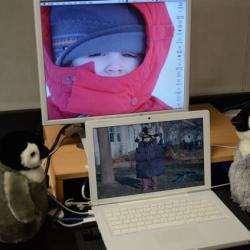
Today we will reach Punta Arenas, Chile. Everybody is extremely excited to be back on land. I have mixed feelings, since I probably will not go to sea in any other expedition like this one, but it has also been a long time away from the family, so I am happy to start heading back home. I plan to follow the research being done with the data that we gathered, or at least part of it. I have learned a lot of new things about research in the Polar regions, oceanography and myself. It has been quite a journey. It is time to pack and begin digesting all what has happened I have been finding lately a couple of penguins around my stuff, and finally was able to get a few pictures of them. They must have gotten into the Palmer while we were paying soccer in the ice party. Here they are checking my...

April 22, 2011 Crossing ceremony

Dance troupe in the Palmer
The crossing ceremony finally arrived this morning, but I will not be able to tell you much about it because I could not participate on it. I suffer of chronic headaches, and yesterday's was particularly terrible. I was in no shape this morning for the ceremony. Too bad, since everybody says it was a lot of fun. For the ceremony, people who crossed the Antarctic Circumpolar Circle are walled 'polliwogs', and those who have crossed it are the 'red noses' I did participate last night on a talent show. All polliwogs had to participate. Even red noses had some acts. It was wonderful. The show opened with Wilson's dance troupe. We were nine polliwogs dancing to Michael Jackson's 'Black and white' . Some pretended to be penguins while others were scientists. At one point we all danced...

April 21, 2011 Weight swings

Correct weight measurements on the Palmer
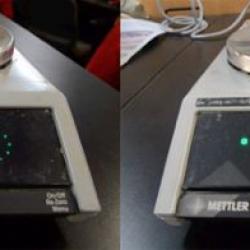
Look at he following picture and What is wrong with the following picture and think about what is wrong. It shows the same laboratory scale with the same objects on top. Same scale gives two correct weights for the same objects due to changes in acceleration There is nothing wrong. The objects are going through what I call weight swings. How can this be? Your weight depends on two things, your mass (how much stuff you are made of), and the acceleration with which you fall to the ground caused by the gravitational attraction with the earth. Acceleration is the change in an object's motion, either speeding up, slowing down or changing direction in which an object moves. In other words, your weight is a force, and Newton defined long time ago a force as the product of the mass and the...

April 20, 2011 Phytoplankton and croissants

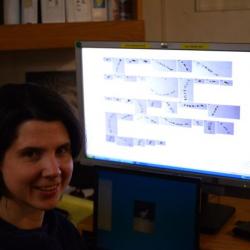
Emily Peacock at her computer
Science is all done on the cruise. People have finished running their samples through the analysis and everyone is busy packing their labs. Seas are still very calm, although there is a bit more swell than in past days. Still very unantarctic What do phytoplankton have in common with croissants? Aboard the Palmer, Emily Peacock is the right answer. Emily is in charge of creating a 'photo album' of as many organisms from the phytoplankton as possible. She works at the Woods Hole Oceanographic Institution (WHOI), in Woods Hole, Massachusetts. Let us find out how she gets the photographs she needs for the album, and what does all this have to do with croissants. Emily sorts phytoplankton after the auto-sorter's first attempt. The picture is a bit dark so you can see the organisms on her...

April 19, 2011 The ghost mooring

Hydrographic station for CLIVAR S4P
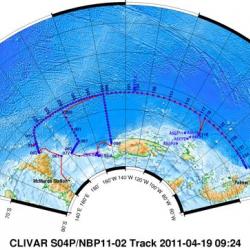
What a way to finish the science component of the cruise! We did our last station this morning, station 140. We did not have any major equipment failure int he whole cruise. Here is the map for the cruise with all the stations we did. I can not believe the cruise is almost over. After so many hours of hard work by all on the ship. All 140 successful hydrographic stations for our cruise Today's excitement about the end of the science sampling was eclipsed by an amazing event, one that oceanographers will talk about for years and years, since it is nothing we have heard of happening before. At the end of last week, a couple of scientists at Woods Hole Oceanographic Institution (WHOI), Dr. Bob Bearsley and Dr. Dick Limburner, hit the oceanographic jackpot. Ten years ago they deployed six...

April 18, 2011 S plus P equals F

Decorated cups to be lowered to the bottom of the ocean
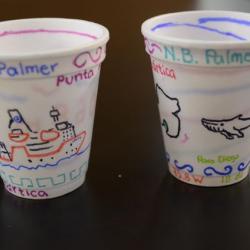
Today's equation is: Styrofoam plus pressure equals fun!! We are almost done with the cruise; we will be done with collecting samples by early morning tomorrow. This means it is time for the long held tradition of sending decorated Styrofoam items to the bottom of the sea along the rosette. Here are the two cups I will be sending, one for each of my kids. Cups decorated for my kids that will visit the dark abyss near Antarctica Why would we want to paint Styrofoam cups and send them to the bottom of the ocean? Here is the not quite short explanation. Pressure is defined as a force acting on a given area (Pressure = Force / area). A force is a push or a pull on an object. Your weight, for example, is the force with what you are being pulled by earth. We can define the pressure you exert...

April 17, 2011 More on penguins

Strinchap penguins in the Southern Seas
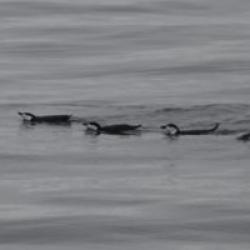
Yesterday we received the visit of six Chinstrap penguins while we were at a station. The remained next to the boat for a long time, apparently feeding. These are the first penguins I have seen that I can say with certainty are Chinstrap. You will see in one of the pictures below why they are named like that. Six Strinchap penguins came to visit us while we were at a estation These penguins look more like ducks on the surface of the water than what we had seen with the Adélies, because their bodies are stick out more above the water. In fact, when we were talking about the visit at dinner time, Kevin said he had seen some birds floating close to the bow, but thought they looked like ducks or other large flying birds. You might be able to see the chin strap that gives these penguins...

April 16, 2011 The big idea: sea water property changes linked to climate change

Dr. Alejandro Orsi, professor in Oceanography at Texas A and M University.
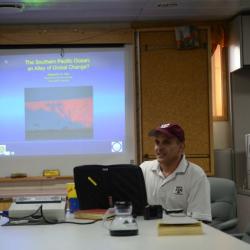
Finally, a week later, I present to you the materials from Dr. Alex Orsi's science talk. This might be the most technical entry of the journal, but it is also the most important as it presents preliminary results of the science being done aboard. It has more acronyms that I would like, so I ask you to be patient to the text and to read it a couple of times to fully understand the main idea from the cruise, which is spelled on the title. Anne Marie, a PolarTREC teacher that finished her expedition two months ago along the very same waters we have been navigating, asked me a very hard question to answer. Before I get to her question, let me recommend you read her journal so you can make a simple comparison and observe the most obvious changes that two months brought to these waters. Her...

April 15, 2011 Do penguins fly?

Penguin on an iceberg
I thought everybody knew penguins do not fly until one of my students waited until the end of the class, when everybody had left the room, to tell me, not to ask me, but to tell me, that penguins do fly. I tried to explain that even though penguins are birds with wings and feathers, that they do not fly. 'I will show you' he said, full of confidence, 'can we watch youtube on your computer?' I said yes, and so there it was, the indisputable proof of flying penguins by the BBC. I would say our society is in trouble we are in trouble when our students believe youtube more than their teachers, but that video is pretty well done. I cannot link the video here, but do search for it in youtube as 'BBC penguins fly', or something like that; you will be amazed. Despite the video I know penguins...

April 14, 2011 Sampling for trace metal analysis

Rosette for trace metal sampling
I have been visiting the trace metal lab and I am ready to report more about how they work on the ship. The way this team works is very different from the way people working on the main rosette do. If you read the journal of the 21st of March, you might remember the following about trace metals: Trace metals are metals that are dissolved in water at en extremely low concentration (a billionth of a gram in a liter of water) Phytoplankton, the marine plant-like organisms that float on the surface of the water and obtain their energy from the sun through photosynthesis, need those metals to survive like we need vitamins. There are parts in the surface of the worlds oceans in which phytoplankton is not abundant even when there is enough sun and nutrients. This areas do not have enough trace...

April 13, 2011 Day or night?

waxing gibbous moon behind the fog
Today we have a small journal entry as I was preparing for tomorrow's live event. I hope to hear a lot of you there. Last night I looked out the porthole and saw what appeared to be a clear night. I have been waiting for a night like this to take pictures of the southern stars, but not only the night was not clear, we had a half moon (waxing gibbous moon) illuminating the sky. Well, when it could pass the low clouds or thick patches of fog in the horizon. Half moon (waxing gibbous) behind the fog Today, as I was working on the presentation for tomorrow, I saw the sun behind another bank of fog, and thought I would take a picture. I used a fast speed to get this picture of the sun, and it came remarkably similar to last night's moon. Day or night? Sun behind the fog It is hard to...

April 12, 2011 Heading north

The Swedish Icebreaker Oden. Picture by Swedish Polar Research Secretariat
We are heading back north after our failed attempt to reach the still elusive continental shelf in front of the Admundsen Sea. We were bogged down by the snow on the ice, since the ice itself was not very thick. The Palmer would have been able to cut through had it been pure ice, but the snow creates more friction on the bow of the ship and ends up stopping it. Larger icebreakers have different techniques for dealing with this problem. The Swedish icebreaker Oden, for example, has water sprayers on the bow that work as lubricant and reduce the friction between the ship and the snow. A picture of the Swedish Icebreaker from a cruise in which Jim Swift participated a few years ago. You can see the water sprays lubricating between the snow and the bow. Picture by Swedish Polar Research...

April 11, 2011 On the ice

Palmer's gangway for an ice party
It seemed like we traveled back in time to be kids again for an hour and a half today during one of the most joyful recesses I have attended! The whole science group got to leave the comfortable confinement of the ship for the first time in seven weeks. Folks were ready for the ice party by 9:30 am on the back deck, all geared up with the mandatory float coats and some with full float jumpsuits. A couple of seals came out of the water behind the ship as the welcoming committee, but remained in an unreachable area. The crew had already setup the gangway. Palmer's gangway for an ice party. It could be called 'freedome' The first to land on the ice were Mike and Barry, who looked like shamans performing some sort of exorcism on the ice as they danced around with their long spears. They...

April 10, 2011 Ice stages

Grease ice patches
We are back on the ice, still far from our target location. Sailing is slow even though the ice is not very thick. Alex said it is 1st year ice with lots of snow, which produces a lot of the friction with the boat and slows it down. We have had to stop, back a bit, and then charge forward again. This is called ramming. I am not sure how much ramming we can do before turning back. The ice maps suggest there might be thinner ice ahead. Jim said we will see how far we get by breakfast, since we are running out of time. First year ice, said Alex, what does he mean? This is a perfect time to talk about different types of ice. Perhaps you have heard that inuits have lots of words for naming snow. I have found people on board have quite a few words for naming ice according to its developmental...

April 9, 2011 Heading south

Heading east on the Palmer
We are heading south towards the Amundsen Sea! We should be back in the ice sometime tonight (correction, we are on the ice now!). This is exciting because we get so see more penguins and seals, and, best of all, we might get to walk on the ice for a couple of hours if the weather is good. We have scheduled a two hour break on the ice for Monday morning; I wonder how my body will adjust to a non moving surface. But as I wrote, it all depends on the weather, so we might be disappointed. Heading east on the Palmer, before turning South towards the Amundsen Sea Todays entry is a short one. I am working on a piece around Alex's talk today and need his input. He is on the night watch, so his comments will come late for today's posting. Meanwhile here is a recently sighted iceberg. Recently...

April 8, 2011 The bridge

Palmer's bridge
What do you think if we visit the captain and the mates up in the bridge today? After all, that is where the navigation takes place. Before we do so, close your eyes and imagine what the bridge might look like based on the books you have read and the movies you have watched; perhaps you have been in different boats and have a very good idea of what we are about to find. Based on my media-driven view of a bridge, I was a bit disappointed when I went to see the bridge for the first time. I was expecting the captain standing in front of a very large wheel while steering the ship. I knew there would be no parrot on his shoulder or a large shiny bronze funnel on his side through which he would yell to the engineers down in the engine room how fast he wanted the ship to go. Let us go up the...

April 7, 2011 Other stopwatches: CFC and SF6

Snowy but calm winds
Sampling for CFC and SF6
We learned before that the amount of tritium in water can be used as a stop watch. Today we are going to learn about other tracers used for determining the age of water masses, CFCs. We are going to follow the team that measures the CFCs from sampling to analysis, but we will begin with a small introduction to CFCs for those who might need a refresher. Skip to 'Why measure CFCs?' if you do not need the introduction. CFC is an abbreviation for man made compounds called chlorofluorocarbons. These compounds were developed in the 1930's to be used as refrigerants and aerosol propellants. They were widely used in industry because of their useful and unique properties. They condense and evaporate in a small pressure range compare to other gases, which make them great for cooling systems such...

April 6, 2011 Mundane activities

Laundry time at the Palmer
We will continue today with our 'Life aboard the Palmer' series. We have talked about cutting edge science being done in one of the most remote areas of the world, we have seen amazing animals that are very hard to see in the wild, and we have enjoyed of the most amazing views around here. But there are less glamourous mundane activities that we need to do as well. We will have been nine weeks on the ship by the time we arrive to Punta Arenas, almost eleven since I left home. You can imagine I did not bring an enormous luggage full of clean clothes. In fact, you do not need to imagine that since you can see me wearing the same clothes over and over in the pictures. I wanted to travel light and purposely packed very few clothes. It is time to talk about the laundry and other important...

April 5, 2011 The engine room

Guided visit to the Palmer's engine room
Another stormy day with science on hold. After six weeks my body is finally doing a little bit better. Not much, though. If science is on hold and I am not feeling miserably that is something. I have to say I have not had a day in which my stomach feels normal yet, but I am working on that. Today we are going to go where we have not gone in six weeks. We got to visit yesterday the ships innards, the last frontier within the icebreaker: the machine room! The engineers scheduled tours to visit the machine room. I do not know what you imagine when I say 'machine room'. Until yesterday, I imagined a dark, musty room full of greasy machines with lots of moving parts. A little bit like Charles Chaplin's 'Modern Times' but crammed. The experience could not have been any different. We went...

April 4, 2011 A mooring deployment

Design of the mooring we deployed.
You have been reading this journal completely add free, but that is about to change. I am advertising a Live Event in which we will be presenting through the computer some of what has been going on the cruise. We will show slides with the pictures of the trip and talk about the science in them. The biggest benefit is that you will be able to ask us questions in real time. All you need is a computer with internet access, speakers and a microphone (or a phone, if your computer does not have a microphone). Have you ever talked on the computer or phone with scientists in the Southern Seas? This is your opportunity, Technology is amazing! All you have to do is register for the event. I hope to hear you all then. Here is the add: Join us for the upcoming real-time PolarConnect event with...

April 3, 2011 The ADCP for measuring currents

Dr. Thomas Decloedt is in charge of the LADCP
Saturday bring us another great science talk in the Palmer. This time Dr. Thomas Decloedt, from the University of Hawaii, explained the use of the ADCP and LADCP for measuring ocean currents. Dr. Thomas Decloedt, a very friendly scientist aboard the Palmer, is in charge of the LADCP When I have written about the ADCP in this journal I have said they measure the currents in the same way the police measures the speed of a car, but I did not explain how it is done. I will attempt to explain here the doppler effect. Again, there are lots of wonderful books that explain this better than I can do here, so I urge you to read them if you end up confused by my attempt. Think about a time in which you were standing on a sidewalk or seating in your car while it was not moving, and an ambulance...

April 2, 2011 A stopwatch for the oceans

Tubes for sampling water from the rosette to measure helium
It is time to go back to a subject I left unfinished almost a month ago. How do we know the time it takes water masses to move from their place of origin to where we find them? Here is a review of what we have covered about water masses with the date in which I wrote about that topic, in case you have not read those posts. Water masses are large volumes of water that have similar water properties (temperature, salinity, dissolved gases, etc.) [March 9]. Water acquires its properties mostly at the surface of the ocean where it exchanges energy and gases with the atmosphere, receives energy from the sun, and where freezing, precipitation, evaporation and melting occur [March 9]. The exchange of gases between the ocean and the atmosphere depends on the relative values of partial pressure...
Syndicate content