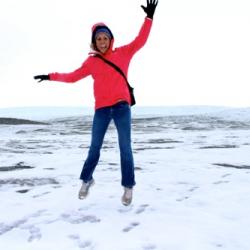
As I prepare to return to school in a few days, I took some time out to reflect on my experience at the American Geophysical Union Meeting. It is hard to believe that there were over 14,000 scientists at this meeting! It was a very busy week. On Sunday I joined Kristin Timm from ARCUS, a polar scientist from UC Berkeley, and fellow PolarTREC teachers Michael Wing and Cristina Galvan. We spent the day working at a science day for the public called "Exploration Station." In our booth we took pictures of participants in Extreme Cold Weather (ECW) gear. They enjoyed trying on the parka named "Big Red" and some families even turned their picture into a shot for a holiday card. We also played Polar Jeopardy. Michael showed items from his expedition to Finland, and...
I am sitting in the second day of the OASIS meeting of scientists at UC Davis, California. We have 32 scientists from many different organizations in the United States, Canada, England, France and Germany discussing their data and results from their 3-month Arctic campaign.
One of the things I stress to my seventh grade students is the importance and "beauty" (I know I'm a little weird to them) of graphing out data. The last two days have been filled with all kinds of graphs!!! It is a science teacher's dream. The scientists have plotted their data with all kinds of other data obtained by other scientists overlaid. Lee Maudlin, an NCAR scientist, pointed out that oftentimes he just starts plotting data sets to see what shows up. You can't really tell what you know...
Summer has finally reached us in Tucson! One of the ways I have been staying cool this summer is creating videos from my PolarTREC experience. It helps looking at snow and drinking ice tea. Enjoy and stay posted for more to come.
[video]
When I was chosen as a PolarTREC teacher to work with OASIS in Barrow, Alaska my brother asked, "Why would a self-professed cold wimp like you volunteer to work in the Arctic in the early spring?" As I thought about it, the answer was much deeper than the temporary insanity that my family thought I was experiencing.
As a teacher I strive to inspire my students. I challenge them to do their best and take pride in their work. There are many opportunities that are available to them now and in the future to explore, appreciate and protect the world. Once they realize that their actions have consequences, they have unknowingly become environmental stewards. Becoming a PolarTREC teacher was an opportunity for me, my students, and my community to explore, appreciate and protect...
I'm not sure why, but the volcano gods that are controlling Mt. Redoubt are smiling down on me. My flight out of Barrow into Anchorage went smoothly as planned. I called my cousin Francie from the baggage claim and she came to the airport to pick me up. I waited outside for her enjoying the "Balmy" -1°C (29°F). I tried making snowballs with the newly fallen snow, but it was still too dry.
After a quick sandwich of smoked salmon (caught and canned by Francie and Jim Pekar), we loaded up the truck with sleds and dogs and headed out to a local course. Francie hooked up 6 of her 7 dogs and two sleds in series behind them. She gave me some quick instructions and we were off on the 3 mile course. As we were on the course she gave me cues as to where to slow down on the...
As I awoke this morning I looked out my bedroom window and saw what Holly Reay and I have officially termed "fogus arcticus". There are so many names for different types of white stuff that fall from the sky along with different types of frost and fog. After spending the majority of my life in the Southwestern Desert, it takes some effort to recall all these new terms. So in our sleepy stupor and in the spirit of Roadrunner and Coyote cartoons we named it "fogus arcticus" for lack of a better name and effort to determine the correct term.
As the days of the OASIS project dwindle, I am finding that the scientists that are still working in Barrow linger a little longer in the cafeteria after meals. The conversation drifts off in many directions with talk of...
Today we left the BARC walked to BASC and went on a scientist field trip to ARM that is run by DOE. After that we toured the CMDL Barrow Observatory that is run by NOAA ESRL. We saw a LIDAR, and instruments that monitor CO2, NOx, CH4, CFC's and the alphabet soup continues. (Don't worry there won't be a quiz on all of these abbreviations).
Now let me explain all of that with words and not just acronyms. If you have been reading my journals, you should know that the BARC is the name of our lab building. BASC is another building here with offices, labs, cafeteria, and Ilisagvik College.
ARM stands for Atmospheric Radiation Measurement which was started in 1989 by the Department of Energy (DOE) to further our understanding of global climate change. They are performing...
This is the third day of very strong winds. Snow is blowing everywhere and doing everything seems difficult today. The visibility is very poor, and I can barely see the road from my laboratory window. It is only about 100 m away. Normally the 0.5 km walk to the BARC building from the cafeteria is enjoyable. Today with a 20 mph headwind and a wind chill of -41°C (-41°F) it is extremely hard. James France and I could be seen crouching down and walking in a line behind Josh McGrath. We followed his every move as if we were cyclists drafting the leader in the Tour de France.
When the winds are that strong, and the visibility low, many scientists are unable to obtain the data they need. In times like this, they decide to work on some other projects they devised while working for long...
Today the wind stopped and the visibility improved so that I could see Russia from my backyard in Barrow. I snapped a photograph of Tim Martin, a fellow PolarTREC teacher working in Siberia, waving at me while he did the same. Check out his blog under Geologic Climate Research in Siberia.
Today would be a great day to stay in the hut and read a book. No such luck. It is very windy outside today. The wind chill is -41°C and -41°F. In Tucson the wind will kick up the dirt into a dust devil. It looks like a mini-tornado, but quickly dies out after traveling a little distance. Outside the window today I saw a snow devil. I'm fortunate that I only need to venture out for short periods at a time to sample snow and walk to the cafeteria.
Last night I woke up at 2AM and glanced out the front window of the hut. I saw a greenish glow in the sky. I quickly pulled on my hiking boots and jacket and ran outside in my pajamas. I finally saw the aurora. It wasn't very bright with all of the lights around. I watched a few moments until I got too cold and then went to...
Michelle Gaspar invited me into her 7th grade class at Eben Hobson Middle School in Barrow, Alaska. There are 185 students total in grades 6-8 at Hobson. We were joined in Michelle's classroom by her teammate's class of 7th graders. They are organized like our 6th grade team at home. Michelle teaches science and math and her partner teaches language arts and social studies. She was amazed that Wilson K-8 has 240 seventh grade students, because there were only about 30 students between Michelle and her partner teacher.
The students and I shared stories about life in Tucson, Arizona and life in Barrow, Alaska. We watched a video that my students created describing life in Tucson. It made it much more real to them when my students explained things. They laughed along with...
In Tucson we enjoy a frozen fruit slush called an Eegee. If you eat one too quickly you can get a headache called a "brain freeze". Today I found out that you can get a brain freeze from the outside in. It was grey, overcast and windy today. You couldn't see very far on the horizon, and the snow was blowing around. Before I went outside to sample snow, I bundled up my head. I wore a balaclava, neck gaiter, wool hat, sweatshirt hood and then a parka hood. It still seemed that when the wind cut in anywhere near my head, I would get a brain freeze.
When I spoke with my daughter today, she was miserable in Tucson. The wind had picked up there and the blowing dust wreaked havoc on her allergies. I still think I would have rather had the blowing dust, just because I...
How do you get a helium filled balloon that is approximately 15 feet in diameter out of a storage warehouse and into a snow field about ½ mile away? The answer in a nutshell, is very slowly and carefully. My task along with six other people was to help Patrick Boylan launch his balloon. The National Center for Atmospheric Research (NCAR) and University of Colorado are doing balloon profiling as part of their research with OASIS. Three sampling lines are attached at different heights along the 500 foot height of the balloon. They will be able to obtain a vertical profile of Nitrogen Oxides (NOx), nonmethane hydrocarbons (NMHC), and peroxyacyl nitrates (PAN). For the non-chemistry members of the audience, this vertical data will be used in conjunction with the surface data to give...
What do you do when you are out on the frozen tundra 13 km (approx. 8 miles) away from the lab while your instrument is acquiring data and your colleagues are working? You can build an igloo if you have an Eskimo to teach you. Holger Sihler found himself in this situation while the scientists from England and France were working in the snow. While keeping an eye out for polar bears, Roy taught Holger to build an igloo.
Holger quickly became an expert in igloo building, despite living in Germany. As they ran out of time, the snow blocks quickly turned into an icy reconstruction of Stonehenge.
The British scientists, James France and Holly Reay, approved of the Arctic version of their landmark.
Today I did an Arctic duathlon. I went for a run and a swim, and fortunately it was not in the same location. I ran along polar bear footprints on the sea ice in the afternoon and swam in a pool in the evening.
The OASIS team from Canada took me along with them to the sea ice. It takes about 20 minutes to reach the sea ice on a snow machine. Stoyka Netcheva piloted the machine while I held on for dear life. I quickly realized that she is an awesome driver and I did not need to squeeze her so tightly. It was surreal riding through land-fast ice; sea ice that is fastened along the shore. The jagged blocks of ice jutted out in all directions and shimmered blue in the sunlight. It is very hard work cutting a path through the sea ice and it took the science team several days...
A researcher who has been here since the middle of February remarked that even God took a day off on Sunday, so we should be allowed to sleep in one day a week. The OASIS scientists have been working very long hours since February without any days off. On Sundays at the BASC, there is no breakfast in the cafeteria. They serve brunch at 11:30 AM, so sleeping until 9:00 AM was a luxury I enjoyed.
Sandy Steffen with OASIS Canada set up a reverse outreach event for us to learn about the residents of Barrow. We had the opportunity to meet Geoff Carroll who works for Alaska Fish and Game. He invited us to join him and his dog sled team for a ride through the Arctic tundra and sea ice.
Geoff is an amazing and very patient person. In 1986 he led a dog sled team to the North...
How is a teacher similar to a SODAR? Teachers constantly sends out questions to their students throughout the classroom and wait for responses. According to students this can be quite annoying especially when daydreaming. This is similar to the SODAR because it sends out sound pulses in various directions and then waits for the reflected sound to come back as a response. This sound can be quite annoying to some people. The frequency of the sound returning depends upon the density of the air it encounters. This is the same with the frequency of the student responses. Just substitute "air" with the word "students" in the previous statement. (Only kidding) The main difference between a SODAR and a teacher is that a SODAR works 24 hours a day 7 days a week. A...
In the video below, Ralf describes his encounter with the polar bear on the sea ice. The background music is provided by SODAR. (I don't think you'll find it on iTunes.)
[video]
Life can be strange. On this first day of spring, I am sitting in a laboratory in the Arctic working on my computer. I am in a room full of people speaking French, while listening to my alma-mater the University of Arizona play in the first round of the Final Four Basketball tournament. I'm not sure which is the strangest part of that whole statement, but I will let the reader decide. (Die-hard UA fans will understand that one.)
Last night several members of the OASIS team enjoyed a delicious Thai dinner in Barrow. The owner, Sonny was the only person working and he did an excellent job serving the 20+ people in attendance. We took up the entire restaurant, so he locked the door outside.
Today we got the opportunity to set up our sampling platform for capturing fresh snow,...
I am learning that there are so many different projects and types of science going on around me, that I have to take my time in getting my head around it all. It is really incredible to see so many scientists working hard all day and night. They are gathering as much data as they can here, and many are taking home samples to further analyze with different equipment at home. It is not possible to have everything shipped to Barrow, so they are doing what they can in the field with lots more work to follow at home. It is amazing to see the collaboration between so many different groups and countries and to realize that this is going to continue long after they all leave Barrow.
Record-keeping is an extremely important piece of any scientific endeavor. Every scientist keeps a...
What do you smell in the snow? That question can be answered in a variety of ways depending on where you live. In Tucson most people only see snow when it comes out of the side of a truck with the label "Raspados" on it. It most likely smells like blue raspberry or Tutti-Frutti. Raspado is Spanish for snow cone and the raspado truck is a very popular place at soccer tournaments. Today in the clean snow field in Barrow we answered the question of smell with a resounding "Bromine."
Harry Beine and Florent Dominé had been smelling bromine in the snow for awhile. Other people were just acknowledging them, but went about their work. Today Harry was encouraged because as we were sampling snow, Didier Voisin, and I also noticed it. Didier immediately went...
After traveling through the night and into the early morning hours, my luggage and I made it to my cousins' Francie and Jim Pekar's house. It was wonderful to have a comfy bed to sleep in. We joined the rest of the Pekar family at a restaurant for breakfast in the morning. I met the newest member of the family, Henry, who is 10 months old. He is totally awesome and enjoyed eating his yogurt treats. His uncle was pretty amazed at the baby food that tastes good, melts in your mouth, packs easily, and is very lightweight! It may end up in his pack on his upcoming 150 mile cross-country ski race in a few weeks.
After breakfast, I got a quick tour of downtown Anchorage, AK. I could see where the city dropped in elevation due to liquefaction after the 1964 earthquake.
Science...
Saying that my luggage and I arrived safely in Barrow, AK is different than saying that same thing about Anchorage, or Seattle or Tucson. The Wiley Post Will Rogers Memorial Airport is quite fun. We left the plane on air stairs, something my daughter has always wanted to do. I quickly donned on my parka, hat and gloves and realized it is different breathing in the air when it is -30 °C. The terminal is less than half the size of my school cafeteria. It was very packed with everyone arriving, everyone leaving on the turn-around of our flight, and the families that were there to greet them in either direction. It was very difficult to move around. The luggage area consists of two openings in the wall and a small ramp to place the luggage upon. It is about the size of an average...
Not only are there several languages being spoken around here there are many acronyms: SODAR, OOTI and DOAS. Today I received a brief introduction to some of them. SODAR measures wind speed and direction every 15 minutes through the layer of the atmosphere from the surface to 1000m above it. Sound pulses are sent into the atmosphere. Microphones detect the sound pulses that are reflected back to the ground. The Doppler shift of the reflected sound pulse is used to calculate wind speed and direction. It is a piece of equipment any 7th grader would love because it chirps away 24 hours a day, 7 days a week. It is non-stop noise. A more detailed picture and description can be seen in the SODAR file below.
OOTI is an acronym for Out On The Ice. The team that was out there...
It has been a whirlwind of non-stop work since I returned from Fairbanks, Alaska on 3/1/09. I finally have all of my sub plans completed! Even though it was only for 2 weeks (I have spring break for one week now), I still left a binder of sub plans instead of just a couple of typed pages. I don't know how the PolarTREC teachers that are going to be out of the classroom longer will be able to do it.
I've been trying to follow the www.oasishome.net/blog as closely as possible during the past two weeks. They have had blizzards, a power outage in their "hut", lots of wind to deal with, a rabies outbreak from the Arctic foxes, and even some pictures of the aurora!!! Harry Beine posted on the OASIS blog, "This is the most extensive atmospheric chemistry measurement...
"Hurry up! We are going to see the end of the Yukon Quest Dog Race!" I quickly donned my winter gear and scrambled through the city blocks of Fairbanks to the frozen Chena River. It readily became apparent that we did not need to rush, since the winners of the race were still not in sight. It gave us a chance to interview a former champion, Lance Mackey. Check out the video below. Sebastian Schnuelle and his dog team crossed the finish line in first with a time of 9 days, 23 hours and 20 minutes. Four minutes later, Hugh Neff and his team of dogs arrived.[video]
Next stop for the day was the ARCUS headquarters to share a potluck lunch of local Alaskan cuisine. I enjoyed the smoked salmon dip and reindeer sausage pizza. Others commented on the delicious moose roast....
Today I attended the Junior Championships Dog Sled Races in Anchorage, Alaska. After arriving in Anchorage at 11:00 PM local time (1:00 AM Tucson time) my cousins Francie and Jim picked me up at the airport and made the short drive to their house. I was amazed at the Christmas lights still on in the neighborhood and Jim explained that Anchorage is the "City of Lights." I can understand how it would be hard to take down Christmas lights when the temperature is below freezing, however it struck me as odd to have extra lights on. Tucson is striving for darker skies in an effort to support the astronomy community. I plopped into bed by 12:30 AM and didn't even feel the earthquake that occurred around 1:00 AM. It was probably more activity from the volcano, Mt. Redoubt,...