Tundra Nutrient Seasonality

Archived PolarConnect Event
PolarTREC teacher Susan Steiner is hosted a PolarConnect event from Toolik Field Station on 7 June 2012.
The archive is now available for this event. Please visit the PolarConnect Archive Page

Meet the Team

Teacher - Susan Steiner

Susan Steiner's picture
Macon Early College High School
Franklin , North Carolina
United States

Ms. Steiner grew up loving the outdoors, spending time exploring the backyard woods with her faithful Bassett hound Falstaff, enjoying family camping trips in the Rocky Mountains, and learning to canoe in the Ozarks of Missouri. A high school Biology teacher inspired her to learn more about the natural world, and early observations of endangered whooping cranes fed the curiosity that led her to major in Biology at the University of Central Missouri. A quest for adventure after graduation led her to the Nantahala Outdoor Center in Bryson City, North Carolina, where she spent a number of years canoeing, backpacking, and exploring rivers and trails around the country. She eventually returned to her biological training, and worked as a research technician at Coweeta Hydrologic Laboratory near where she now resides in Franklin, NC. Besides helping scientists gather a variety of data about soils, forest health, and streams, she volunteered to become involved with a science program for students called the Schoolyard LTER (Long Term Ecological Research) program. She enjoyed teaching authentic science to the kids so much that she decided to return to school for her Master’s degree, this time in Science Education with an emphasis in Biology. She presently teaches high school students at Macon Early College, helping them to learn about and enjoy the natural world through courses in Earth Science, Biology, and Physics.

Researcher - Michael Weintraub

Michael Weintraub's picture
University of Toledo
Toledo , Ohio
United States

Michael Weintraub is an assistant professor in the Department of Environmental Sciences at the University of Toledo, where he studies terrestrial ecosystem and global change ecology. His research program is focused on understanding the mechanisms underlying basic ecosystem processes and how they are affected by impacts such as climate change and nutrient deposition. His overall research goal is to understand the controls on ecosystem processes such as decomposition, and transformations of both inorganic and organic soil nutrients. Dr. Weintraub uses a range of research tools in order study questions that range from the scale of microbial communities up to the ecosystem level. Learn more about Dr. Weintraub's research here [http://www.eeescience.utoledo.edu/faculty/weintraub/csas.htm]

Journals

September 25, 2012 Fall into Phenology!

Fall Leaves
One of my favorite things about fall has always been, and still is, the opportunity to look at the beautiful color changes in the mountains.

July 6, 2012 Good Science, Good Times

view from Dalton Highway just North of TFS in late May
John Muir observed: "When we try to pick out anything by itself, we find it hitched to everything else in the Universe" This journal has been a little delayed, due to an early trip home. All is well, now, and it's good to be back in the lower 48. I always thought that phrase, "the lower 48"...

June 27, 2012 Arctic Birding

Arctic Tern on fence along Dalton Highway near Atigun River
Over the course of my time here, I've run into several groups of birders, as well as had numerous conversations with the bird groups here at camp. I could show you great pictures they've taken of birds or ones I downloaded from the Internet, but I thought you might like to see them from my point...

June 24, 2012 The Arctic Ocean!

gravel bar jetty along the Arctic Ocean
My alarm going off at 4:30 am is not normally something I'm excited about, but today is the day I have reservations to go on the tour to see the Arctic Ocean! gravel bar access to Arctic Ocean I need to drive about 130 miles north of here to Prudhoe Bay, which can be a three hour trip due to...

June 22, 2012 It's a Bird! It's a Plane! It's the Toolik Trolley!

NIMS robotic sensor platform with Brooks Range in background, at Imnaviat site J
NIMS robotic sensor platform No sightseers are getting rides on this trolley, though! It's actually a robotic sensor platform that traverses sections of tundra collecting a variety of information. Traveling about 2m per minute, this very cool device is on the cutting edge of data collection....

Project Information

The Changing Seasonality of Tundra Nutrient Cycling: Implications for Ecosystem and Arctic System Functioning
Toolik Field Station
22 May 2012
1 July 2012

Where are They?

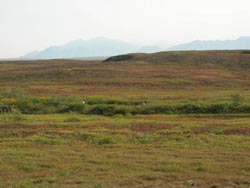
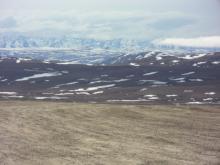
Tundra near Toolik Lake, Alaska
The research team will be living out of Toolik Field Station, located in the northern foothills of the Brooks Range in northern Alaska. The team will commute to their field plots, located approximately 10 miles from Toolik Field Station, by truck. Toolik Field Station is operated by the Institute of Arctic Biology at the University of Alaska Fairbanks and has hosted hundreds of researchers and students every year since 1975.

What are they Doing?

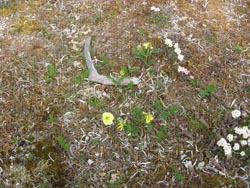
Tundra plants and antler
Arctic soils have large stores of carbon and as the arctic environment warms, this carbon may be released to the atmosphere in the form of greenhouse gases such as carbon dioxide and methane. The current understanding of tundra ecosystems and their responses to climate change is based on the idea that nitrogen limits plant growth, however nitrogen availability is strongly seasonal, with large amounts available early in the growing season but very little available later on.

Since nutrient cycling on the tundra changes throughout the season, the research team will attempt to understand how seasonal changes in tundra plants and soil dynamics are affected by changes in the timing of snow melt and warming. By experimentally manipulating factors such the timing of spring thaw and fall freeze directly on the tundra the team can study how this affects the ecosystem directly. The team will be engaged in a mixture of outdoor field sampling, experimentation, and laboratory work. Through this research the team hopes to better predict the impacts of changing growing season timing and duration on the carbon balance of arctic ecosystems.

Resources

Title Date About Type
The Plot Thickens Overview Small groups of students will establish their own phenology plots for long term study.... Lesson
The PolarTREC Experience: Real Science for you and your students! 8 November 2012 Powerpoint presentation given at 2012 North Carolina Science Teachers Association professional... Presentation
Scientific Research Study Trips 30 October 2012 Presented Powerpoint slideshow including two interactive activities for two 90 minutes sessions of... Presentation
Macon County teacher featured in Macon County Schools Newsletter 1 October 2012 Susan Steiner, Science Teacher at Macon Early College High School, returns from her summer in the... Article
Polar Express, Expedition puts teacher on top of the world 18 September 2012 Article posted in Western Carolina University's alumni magazine Class Notes section about Susan... Article
Macon County,NC - Public Library Display 1 June 2012 - 6 July 2012 Display at Macon County Library while my expedition is ongoing. Also includes a few hundred... Image
Susan Steiner and the Tundra Nutrient Seasonality Expedition 7 June 2012 In this one hour webinar, PolarTREC teacher Susan Steiner and researcher Michael Weintraub explain... Event
Summer on the Tundra: Steiner to Study Arctic Biology in Alaska 20 April 2012 Interview in The Franklin Press about Ms. Steiner's upcoming expedition to Toolik Field Station in... Article

Journal Map

Javascript is required to view this map.