
What Are They Doing?
Solar radiation is the major energy source that drives our climate and supports life on earth. In this project, the research team gained a better understanding of the solar radiation reflected back into space and absorbed by our planet, also known as the Earth’s heat balance. The team collected data related to this balance using weather observing instruments and a specially equipped aircraft that detected wind speed and directions and electromagnetic radiation.
The measurements were part of an international effort to record radiation called the Baseline Surface Radiation Network project. The data collected was used to further study the Greenland Ice Sheet and it’s processes such as melting and gas exchange with the atmosphere.
Studying heat balance is an important concept in climatology because light surfaces, like snow, reflect more radiation back into space while dark surfaces, like water, absorb more radiation. When you have snow cover, about 90% of the solar energy that goes through the atmosphere is reflected back into space. But increasing the amount of water on the Ice Sheet causes less radiation to reflect and more heat to be absorbed. This increases the temperature and causes more ice to melt.
Where Are They?
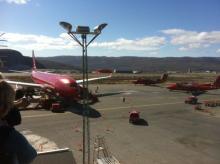
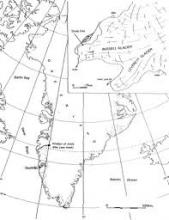
The research team traveled from the United States to Kangerlussuaq, a small community in western Greenland. From Kangerlussuaq, they traveled by small plane to several stations across Greenland including:
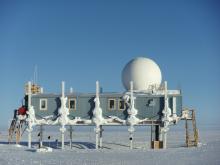
- Summit Station, a major research station located at the peak of the Greenland ice cap atop 3216 meters (10,551 ft) of ice.
- NEEM, a small research facility on the northern Greenland Ice Sheet, used as a base for ice core drilling.
- Swiss Camp, a very small research camp consisting of several insulated tents towards the edge of the ice sheet in western Greenland.
Latest Journals
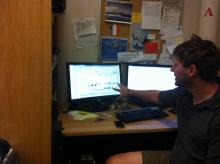

Jim Pottinger’s interest in science began as a young child when he was given the supervised and unsupervised time to experiment with science kits and everyday household items (some explosive, some not!). His passion to study science was passed on to him by great educators during his scholarly journey, from elementary and high school in Mount Pleasant, Pennsylvania to undergrad at California University of Pennsylvania and eventually as a graduate student at the University of Pittsburgh studying beach ridges on St. Catherine’s Island. Today, Mr. Pottinger strives to inspire his students and community to embrace all that science has to offer.
Currently, Mr. Pottinger lives, works, and plays in Southwestern Pennsylvania where he works with gifted students at Gateway School District as a resource teacher and instructs astronomy students online and face-to-face at Westmoreland County Community College. He personally enjoys engineering, geology, and being an eternal student. Jim is currently completing his EdD in Educational Technology Management at Northcentral University with plans of being more involved with educational outreach through the use of technology. He enjoys alpine skiing, mountain biking, and being outdoors with his wife and three children.
Mr. Pottinger enjoys teaching because it involves the opportunity to engage fresh minds and the opportunity to share his excitement and passion about science with others. He hopes that being involved with PolarTREC will inspire other teachers and students to become stewards of the earth by getting involved in projects from the smallest level like recycling at home to larger levels such as being involved in a sustainability group in their communities.

Dr. Konrad Steffen is a professor of geography and the Director of the Cooperative Institute for Research in Environmental Sciences (CIRES) at the University of Colorado at Boulder. His research interests lie in the interactions between climate and snow and ice covered regions, in particular changes in ice sheets and sea level. Dr. Steffen has spent over thirty years conducting research in the arctic, much of which is in Greenland. To learn more about Dr. Steffen, please visit his faculty biography page (http://cires.colorado.edu/people/steffen/).