Siberian Arctic Systems Study

The Polaris Project participants will be blogging through the PolarTREC website as well as through the Polaris Project website! Don't miss a thing and be sure to read all the great blogs from Mark and the students!

The Polaris Project participants have been hosting weekly webinars in preparation for their expedition. A public presentation given by Andy Bunn on climate change is now available in the PolarConnect Archives.

Meet the Team

Teacher - Mark Paricio

Mark Paricio's picture
Smoky Hill High School
Aurora , Colorado
United States

Mark Paricio is a national board certified science teacher at Smoky Hill High School in Aurora, Colorado, where his guiding principle is that "Science, like life, is NOT a spectator sport." Having worked as a chemical and environmental engineer in the nuclear industry prior to teaching, Mark stresses using a multidisciplinary approach to learning about and solving scientific problems. To this end, Mark has worked to create opportunities for his students to work with professional engineers to design sustainable buildings and communities, as well as to investigate alternative transportation issues. Mark teaches his students to view their world as part of the whole – and that understanding this system is critical if they hope to contribute significantly in their future. Mark is excited to bring the experience of his PolarTREC research expedition back to the classroom to inspire students to go out and pursue science in their lives and to make a difference. Mark is a past Colorado Physical Science Teacher of the Year. When not teaching, Mark is busy traveling with his family or enjoying hiking, skiing, or cycling in the Colorado Mountains.

Researcher - Max Holmes

Max Holmes's picture
Woods Hole Research Center
Falmouth , Massachusetts
United States

Dr. Holmes is an earth system scientist with broad interests in the responses and feedbacks of coupled land-ocean systems to environmental and global change. Most of his current research focuses on large rivers and their watersheds and addresses how climate change and other disturbances are impacting the cycles of water and chemicals in the environment. Dr. Holmes has several ongoing projects in the Arctic (field sites in Russia, Canada, and Alaska) and has more recently begun working in Africa, Asia, and South America (Amazon, Congo, Ganges, Brahmaputra, and Yangtze watersheds). He has also studied desert streams in the southwestern United States, stream/riparian ecosystems in France, and estuaries in Massachusetts. He is strongly committed to integrating education and outreach into his research projects, particularly by exposing K-12 and undergraduate students to the excitement of scientific research.

Journals

July 31, 2012 Reflections on my PolarTREC Experience in Siberia

After the past month in Siberia, my thoughts focus on the remarkable vision of the Polaris Project, on the extreme difficulty of doing Arctic research in Siberia, and on the remarkable people I met throughout this expedition.

July 23, 2012 5th Annual Polaris Project Symposium.

Maddie LaRue presenting her research
Last evening, the undergraduate and graduate students of the Polaris Project presented the results of their research at the 5th Annual Polaris Project Symposium. To do this, we transformed the dining hall of Orbita into a conference center. Each of these 15 students presented their research for...

July 23, 2012 Parting Shots – A Cold, Windy, Snowy Day

Scott Zolkos and snowflakes
On our last full day (so the schedule would have us believe) at the Northeast Science Station, I am reminded of our first full day here. It’s the weather. It snowed on us then and it snowed on us again today. Actually, yesterday reminded me again of Colorado, a beautiful summer morning followed...

July 22, 2012 Polaris Project Student Research – Eric Taber (Colgate College) and Sam Berman (Clark University)

Eric Taber and Dr. Mike Loranty of Colgate
To me as a teacher, one of the most rewarding aspects of the Polaris Program is watching mentoring relationships develop between students and researchers from the same university. Taking education out of the confines of the university and into the field, raises the level of thinking and problem...

July 22, 2012 Last Minute Tree Sampling

Mike Loranty (right) takes a tree core while Seth Spawn measures the tree
Over the last two days, many of us accompanied the researchers out to collect any nonpermanent sampling equipment, place long-term equipment to gather data over the next year until the Polaris Project returns, and take any final samples. Learning to take Trees Cores Last evening and this morning...

Project Information

The Polaris Project
Cherskiy, Siberia
26 June 2012
26 July 2012

Where are They?

Kolyma River winding through northern Russia
The research team will travel from the United States to Moscow, then on to the research station at Cherskiy, north of the Arctic Circle. Once at Cherskiy the research team will be living and working primarily on a barge on the Kolyma River, one of the most remote rivers in the world. The barge provides a unique dormitory but also serves as a mobile lab, allowing the team to tow the barge to various locations on the river for different studies.

What are they Doing?

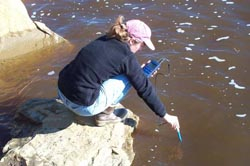
Sampling river water
The Polaris Project is an innovative international collaboration among students, teachers, and scientists. Funded by the National Science Foundation since 2008, the Polaris Project trains future leaders in arctic research and informs the public about the Arctic and global climate change. During the annual month-long field expedition to the Siberian Arctic, undergraduate students conduct cutting-edge investigations that advance scientific understanding of the changing Arctic. During the Polaris Project field course, students and faculty work together to study the Arctic as a system. Instead of focusing on a single question in a single ecosystem type, the group considers a range of questions across multiple components of the Arctic System including forests, tundra, lakes, rivers, estuaries, and the coastal Arctic Ocean. The unifying scientific theme is the transport and transformations of carbon and nutrients as they move with water from terrestrial uplands to the Arctic Ocean. They emphasize the linkages among the different ecosystems, and how processes occurring in one component influence the others.

Resources

Title Date About Type
Polaris Project Session Five: Public Presentation 31 May 2012 This is a one hour webinar is part of the Polaris Project 2012, conducted by Max Holmes and John... Event
Polaris Project Session Four 24 May 2012 This is a one hour webinar specifically for the participants of the Polaris Project 2012, conducted... Event
Polaris Project Session Three 17 May 2012 This presentation is part of the Polaris Project Webinar Series preparing participants for the... Event
Polaris Project Session Two: Sobczak Presentation 10 May 2012 This presentation is part of the Polaris Project Webinar Series preparing participants for the... Event
Polaris Project Session Two: Schade Presentation 10 May 2012 This presentation is part of the Polaris Project Webinar Series preparing participants for the... Event
Polaris Project Session One 3 May 2012 This is a one hour webinar specifically for the participants of the Polaris Project 2012, conducted... Event