
What Are They Doing?
During this multi-year, multi-location project, the research team collected and analyzed archaeological and paleoenvironmental data from three widely separated but environmentally comparable sites within the northern circumpolar region: the Yli-li area of Northern Finland, the Wemindji area of James Bay, Canada, and the Kamchatka Peninsula region of Russia.
Working on the Kamchatka Peninsula, the research team examined prehistoric human responses, or adaptations, to changes in climate and the environment that took place between 6,000 and 4,000 years ago. Due to its extreme climatic conditions, the circumpolar North can be a challenging place for human survival. By studying the lifestyles of these prehistoric humans, the research team can better understand how the prehistoric humans were able to survive and adapt to changes in the harsh arctic environment.
Data gathered from this project enabled more effective collaboration between social, natural, and medical sciences. The International Collaborative Circumpolar Archaeological Project (ICCAP) is a continuation of the International Polar Year, Histories From the North: Environments, Movements, Narratives (BOREAS) project of the European Science Foundation and the U.S. National Science Foundation's Social Science Polar Program.
Where Are They?
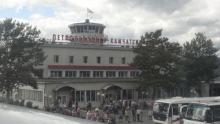
The team was based out of a remote camp near the Pacific Ocean on the Kamchatka Peninsula, a long peninsula in the Russian Far East. To the east of the Peninsula is the Pacific Ocean, and to west is the Sea of Okhotsk. The peninsula has a high density of volcanoes – about 160 volcanoes, 29 of which are still active.
Latest Journals


Claude Larson feels a connection with the natural world and enjoys the rural setting of her home environment of northwestern New Jersey. In her sixteenth year of teaching, Claude currently teaches 8th grade Physical Science at the Jefferson Township Middle School in Oak Ridge, New Jersey. She believes that science is everywhere and seeks to inspire students to make connections with the world around them through her lessons. In her free time, Claude enjoys many outdoor pursuits, skydiving, travel, and creating mixed media art.

Dr. Ezra Zubrow is a professor of anthropology at the University of Buffalo and also holds academic positions at the University of Toronto and Cambridge University. He is also Senior Research Scientist at the National Center for Geographic Information Analysis Laboratory, which he helped found. He has a diverse set of academic interests: arctic archaeology and anthropology, climate change, human ecology and demography, as well as a deep interest in social issues (heritage, disability, and literacy). For more than 30 years he has been doing field work in Northern Canada, Finland, and the rest of Scandinavia, and he originally pursued a career in science because one of his high school teachers persuaded him to participate in an ozone-tracking project. To learn more about Dr. Zubrow, please visit his faculty biography page (http://wings.buffalo.edu/anthropology/Faculty/zubrow.htm).

Dustin Keeler is a PhD student in archaeology at the State University of New York at Buffalo. Mr. Keeler's research interests include studying people of the Paleolithic and Neolithic, or the Stone Age, human settlement patterns, Northern and Western Europe, and mapping using GIS. He has participated in archeological excavations in France for several years and is currently conducting surveys and excavations on Neolithic sites in Northern Finland.

Greg Korosec is a PhD student in anthropology at the State University of New York at Buffalo and the assistant director of the University at Buffalo's Social Systems GIS Laboratory (http://wings.buffalo.edu/research/anthrogis/). Mr. Korosec has been returning to the circumpolar north for the past several years where he is interested in the human adaptation, evolution, and responses to a changing past environment.
Joanne Bourgeois is a Professor in the Earth and Space Sciences Department at the University of Washington. Her main research interests include sedimentary structures and tectonics. Dr. Bourgeois also teaches and researches the history of geology, believing that exploration of how science is done leads to better science. Dr. Bourgeois has also served a two-year term as a Program Director in the Earth Sciences Division of the National Science Foundation.
Biography coming soon.
Biography coming soon.
Biography coming soon.
Biography coming soon.
Biography coming soon.