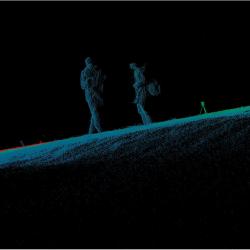
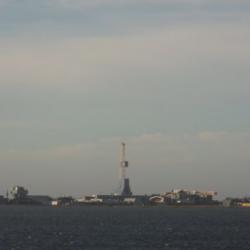
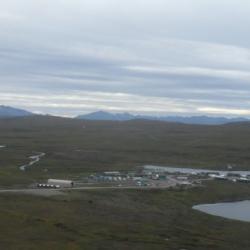
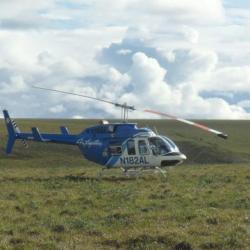
During the decades that Dr. Jesse Walker has been performing research, technology has taken leaps and bounds. The satellite images that depict the Colville River Delta were not available in his first years or research… neither were the DGPS units, LIDAR, much less cell phones that we used in the field this August.
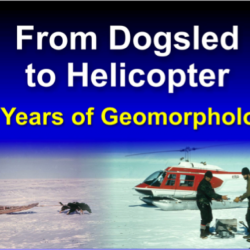
On Sunday, November 7th, I visited Dr. Jesse Walker, professor emeritus in the Department of Geography and Anthropology at LSU. Dr. Walker has conducted geomorphology research along the Colville River in Alaska’s North Slope for over 50 years. His seminal trips to the Arctic took place before the infrastructure of the oil industry had been established. Instead of relying on the (relatively) well-connected airstrips that our CALM team utilized this August, Dr. Walker traveled...
Temperatures are cooling off in New Orleans, a sign that the first grading period is drawing near, and that it's been over a month since my return from the Arctic. It is remarkable how frequently my time in the tundra finds relevant avenues into classroom conversation. Inquiries about warm blooded and cold blooded animals lead to discussing how arctic creatures conserve heat. A lunch-time question regarding fishing in Louisiana grew into an explanation of sustenance hunting on the North Slope. More formal lessons incorporating our expedition's content are slated throughout the semester and beyond: I will visit a local Arctic researcher in Baton Rouge later this month, and am awaiting response from a BP community outreach center in order to organize respective labs and field trips. Next...
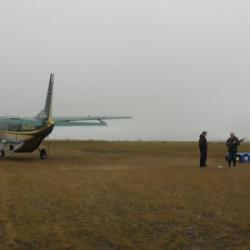
My final day in Barrow did not see much idle time. Fritz and I hit the field early, in an effort to install a data-logging tripod at our CALM grid. Alas, we were met by road closures, and had to leave the task in the capable hands of BASC staff members for a later date. I drove Fritz, Dima, and Kelsey to the airport where their plane barely beat the fog out of town. The three researchers will head to Nome, Alaska for a few more days of probing and data logging before returning home.
After the drop-off, I returned to yesterday’s meat cellar to install the new data logger. I was cautious enough to wear full rain gear this go around, so that my clothes beneath would remain largely blood and odor free.
I was privileged to give this week’s Schoolyard Talk at the Barrow Arctic...
I roused my team at 6:00 am for a live chat with my classroom back in New Orleans. Ms. Sledge, my stellar substitute, and Mr. Inocian, my Schwarz tech guru, helped square away 2nd period for a phone conversation and PowerPoint presentation with Fritz, Dima, Kelsey, and I. I appreciate each of my team members for rising early to share a bit of our research with those back home. We managed an encore of the presentation later in the day, during which my students were particularly impressed with the price tag of the LIDAR equipment ($250,000) and that of a bag of Tostitos here in Barrow ($8.50). Students were also curious about the flora and fauna of the arctic (no, there aren’t penguins in Alaska), and lifestyles of folks on the North Slope (yes, kids play football). It was great to...
After trudging through tussocks, puddles, and muck, traversing tens of kilometers of tundra, and probing hundreds of thaw depths, my final CALM grid was visited today. As if each grid in Prudhoe, Toolik, and Barrow served as training, today's sampling in Ivotuk proved to be the most backwoods stretch of North Slope yet encountered. There are no inhabitants at Ivotuk (despite what the sign might indicate), only a few structures erected by a handful of Arctic researchers like the CALM crew. A small Cessna was required to reach our site, located about an hour and a half south of Barrow. The airstrip itself is a long gravel road, put in place by the BLM for mineral exploration in decades past. The sign welcoming those to Ivotuk is right in one regard: 'If you're here,' the sign reads, 'you're...
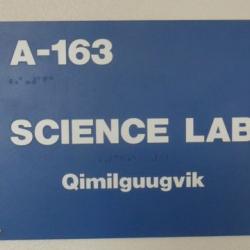
Today was the first day for students at many North Slope Borough public schools. Tim Buckley, a science teacher at Barrow High School, allowed Kelsey and I to poke around the Whaler's campus for the afternoon. In addition to teaching AP Physics and Chemistry classes, Mr. Buckley also heads up a Global Information Systems (GIS) course for upperclassmen. Taught in concert with representatives from the North Slope Borough, this course certifies students for GIS operation - an extremely marketable skill at this day and age. The students' GIS and chemistry labs rival those of many a college campus. All placards labeling rooms throughout the school included the Inupiaq translations of the given word.
Mr. Buckley's Chemistry and Physics Lab at Barrow High School
On the way to our field...
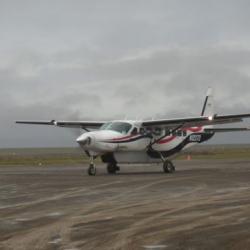
While the Haul Road connects Prudhoe Bay to the rest of the state, the vast majority of towns in the North Slope Borough of Alaska are not accessible by road. So when our field site required us to trek out near the small village of Atqasuk, we were required to fly the short 60 miles from Barrow.
The aircraft which transported us between Barrow and Atqasuk
Several trucks and four-wheelers – a healthy showing of the 250-person city – arrive at the Atqasuk Airstrip to help haul supplies at every aircraft landing. We were graciously offered a ride into town once we touched down, but declined, seeing that our site lay about a mile into the tundra. The ground was particularly wet as we probed thaw depths, and a drizzle kept things soggy all morning. As one of the most remote...
Cathy, Kelsey, and I boarded a Barrow-bound plane in Prudhoe Bay this morning. We left Anna and Elliot to finish gathering data at sites across the oil field and back at Toolik Field Station. In Barrow, America’s northernmost city, we reunited with Ellen Hatleberg and Dima Streletskiy, along with Dr. Fritz Nelson (University of Delaware) and Marianne Okal (UNAVCO).
We were quickly acquainted with the Barrow Arctic Science Consortium (BASC), our base of operations for the next several days. There, we received a safety and logistics briefing with special emphasis paid to polar bear awareness. There have been sightings in the area over the past several days, and we were asked to report any encounters of our own immediately.
The crew carries LIDAR equipment to a field site....
I’m writing from Prudhoe Bay, Alaska, hoping everyone had a great weekend in New Orleans and beyond. We just arrived back in Prudhoe this evening after a final day at Toolik Field Station. Tomorrow morning, we fly out to Barrow, Alaska, where we will be “base camped” for the remainder of the expedition.
Because of the clear weather, we were finally able to see the infrastructure of Prudhoe Bay for the first time. America's largest oilfield looks much grander when it is not shrouded in fog.
Check out the weather information at the bottom of the page, and you may have a hard time believing we’re in the Arctic at all. Today was clear and comfortable, and made me wish we had another day left in the helicopter (see the photos and journals for our chopper travels on August 13 and 14...
Aware of the delicate role that weather plays in our flight plans, we awoke this morning to assess the conditions outside. With the skies clear, the prospects looked good for our second day aboard the chopper.
An arial view of Toolik Field Station, taken from our helicopter. When I asked our helicopter pilot to estimate our visibility today, he answered, 'Limitless.'
Today’s tasks included uploading data from five monitoring stations spread across the area. Each site we visited was distinguished only by one metal tripod, equipped with two small, white objects (a radiation shield and data logger). As you might expect, from a helicopter, these tripods occasionally proved difficult to spot. One of our jobs for the day involved making sure the sites were easily distinguishable for pilots...
If I had thought that the field sites we had visited thus far were off the beaten path, I was in for an awakening today. For two days, our team will be dropping in on sites so remote they require a helicopter to access. We have had a history of cloudy days on our expedition thus far, which has inhibited our view or Arctic scenery, but hasn’t interfered with our ability to collect data. When a helicopter is in the picture, a foggy day can change things drastically…
Our primary method of transportation during August 13th and 14th.
After we received the go-ahead from the helicopter coordinator at Toolik, Cathy, Elliot, Kelsey and I drove up the Dalton to ‘Happy Valley,’ a glorified roadside pullout originally created as a camp for pipeline and highway workers. ‘Happy Valley’ is...
First things first, I’d like to welcome all Schwarz staff and students to the first day of school! I hope everyone has stayed dry through the inclement weather, and that all enjoyed their extra day of summer due to school closings yesterday.
A shot of Schwarz from back home in New Orleans.
Here in Alaska, we left Prudhoe Bay this morning, bidding farewell to the Arctic Ocean just as the weather began to clear up. Our team took two trucks south down the Dalton Highway to Toolik Field Station, where we will be stationed for the next several days.
On the road, we stopped at two different field sites to collect thaw depth measurements. Check out this video to see just how we measure ‘active layer.’
Our drive up to Prudhoe Bay was shrouded with thick fog, and prohibited us from...
Today, our team divided and conquered.
Anna and Kelsey headed off to repair some of the chewed and water-logged data loggers discovered yesterday, before retrieving information from another Flux plot. Dima, Cathy, Elliot, and I headed across the oil field to West Dock, a CALM site identical in layout to the Betty Pingo site probed yesterday. Each of these CALM sites are 1 kilometer grids, with poles stuck in the ground every 100 meters. Because there are lines of poles on either end of the 1 kilometer plot, there are 11 rows and 11 columns of poles (121 in total) spread evenly across the tundra. At each of these 121 poles, two measurements of thaw depth (active layer) are taken. That accounts for a whopping 242 measurements, and several kilometers of walking in between! Elliot and I were...
This morning began with a bit of gear retrieval… While many of the sites we will visit have been monitored for 15 years, a relative newcomer to the team’s data collection is the Differential Global Positioning System (DGPS). This equipment will identify the latitude and longitude and the elevation of points measured. It is easy enough to identify where the active layer begins below ground - that impenetrable barrier where permafrost begins; however, the depth of the active layer can’t be accurately determined unless one also knows its top lies. The DGPS will tell us the elevation of ground level, and allow us to determine how ground level changes over time. So far, data has shown that the soil surface above the arctic active layers has gone down over time. This sinking...
Prudhoe Bay is a wild place. Although the sky never goes completely dark, frequent fog often limits vision to a few car lengths. Temperatures reach highs in the 30’s in August, and polar bears, musk oxen, and caribou wander at will. Despite this austere scene, Greater Prudhoe Bay is - in most regards - state of the art. Multiple flights depart and arrive from two airports several times a day. High speed internet links different outpost across the tundra almost instantly, and inside these outposts, steak dinners, flat screen tvs, and up-to-date workout facilities accommodate the seasonal and permanent workers of BP’s oilfield operations.
While spartan from the outside, inside, the BP 'BOC' has living facilities, recreational facilities, office space, and even an arboretum....
Apologies to all for the delayed entry. We were experiencing a bit of internet difficulty after arriving at Prudhoe Bay late Sunday, August 8th. I'll catch you up on the journey, and let some pictures help tell the story…
The start of the Dalton Highway begins as a paved road North of Fairbanks.
Cathy, Anna, Kelsey, Elliot and I left Fairbanks about 8:30 am aboard the F-350 Super Duty. The Dalton Highway (also known as the Haul Road and Alaska Route 11) is a 414 mile paved and gravel road beginning at its intersection with the Elliot Highway (Alaska Route 2) near Livengood, AK in the South, and ending at Deadhorse next to the Prudhoe Bay oil fields and the Arctic Ocean. Incidentally, this is the same fabled path that daring drivers face on the History Channel's series Ice Road...
The beginning of our journey north coincided with the first clear morning we saw in Anchorage. We were on Highway 3 by 9:30 am, with Dima and I trading off time at the wheel. We made a brief pit stop in Wasilla, Alaska – the town formerly mayored by the famed one-time vice presidential candidate. Road construction and brief, intermittent showers served as our only obstacles on the journey. We passed through Denali National Park, although clouds obscured our view from Mt. McKinley itself. We arrived in Fairbanks at about 4 pm, just in time to pick up Drs. Anna Klene (University of Montana) and Cathy Seybold (USDA) from the airport.
After dinner, the crew headed to the goliath grocer, Fred Meyers, for some last minute supplies. Tomorrow morning, Anna, Kathy, Kelsey, Elliot and...
The rain did not relent for our last day in Anchorage, though it also did not stifle a scenic drive to Chugach National Forest along the Cook Inlet. After arriving at the forest’s visitor center, Ellen, Dima, Elliot, Kelsey, and I trekked to the foot of the Portage Glacier. Dima, our resident glacier expert, explained how the moving ice forms were responsible for carving out U-shaped valleys. He also described the process that is responsible for the blue shades of glacial ice: as snow and ice accumulate, the ice beneath becomes compacted, and air is effectively “squeezed out.” This dense ice absorbs light more readily in the red and yellow spectrum, reflecting the blue light we are able to see. Ice on the surface of glaciers – as well as snow in general – tend to reflect light of...
Dima, Kelsey, Elliot, and I rendezvoused for an early morning with Ellen Hatleberg, a graduate student at George Washington University, who’s family now calls Anchorage home. Per her suggestion, we feasted at Gwennie’s Old Alaska Restaurant, a colorfully decorated tavern-turned-eatery, where meal portions put the phrase “Texas-Sized” to shame.
We arrived downtown at the Anchorage Museum for its opening. Having just undergone an elaborate expansion, the museum offers visitors a comprehensive take on art, history, and science through an Alaskan lens. One of our primary objectives in visiting was to check out the Smithsonian Arctic Studies Center, an exhibit of rare Native Alaskan artifacts.
This Sydney Lawrence painting exhibited in the Anchorage Museum...
A day spent between 8 am and 5 pm in a classroom may not sound like the most engaging way to spend one's first day in Alaska. And while that's exactly what happened - readers, have no fear - my Wednesday was by no means a lecture laden day in the doldrums. Elliot Upin, Kelsey Nyland, and yours truly were required to undergo the North Slope Training Co-operative (NSTC) "Unescorted North Slope" Safety Orientation. This course equips us to travel in otherwise restricted areas of the North Slope Borough, limited in access because of special environmental concerns and potential hazards due drilling infrastructure. The vast majority of our fellow students in the NSTC course were workers from Germany and across the US, preparing for six-week stints at Prudhoe Bay and surrounding oil fields...
After some final tune-ups at Schwarz this morning, I left New Orleans for Alaska around 11 am. A Chicago layover later, and I arrived in Anchorage at 8:45 pm Alaska Standard Time (11:45 pm Central Standard Time). Along the way, we flew over the Yukon Territory where clouds gave way to snow-covered mountains and glaciers.
A snowy shot of the Yukon from the window of my Anchorage-bound plane.
At the airport, Dima - a post-doc who will begin at George Washington University in the fall - and I met to collect bags, a rental car, and head to the hotel. We briefly rendezvoused with Elliot and Kelsey, two George Washington students with whom I'll be taking my North Slope Training Cooperative course tomorrow. As all were tired from a day of travel, we returned to the hotel after dinner to...
The final day in NOLA before the adventure begins was spent preparing class to begin in my absence. The room was set up, lesson plans were printed, our school's computers - which will be heavily utilized as our students tag along with the Arctic expedition - were logged onto the PolarTREC website. While I must leave most of the classroom behind, last spring, Schwarz students created a flag that will proudly accompany me in my journey north. A few adjustments to the Schwarz flag, which will be debuted in Alaska!
Back home, some sweet goodbyes were said, and my duffle bag was packed with all the gear required for three weeks of permafrost prowling. I'm off in the morning, and will update all tomorrow upon my arrival in Alaska.
Donning my mosquito net shirt - part of the gear issued by...
With our expedition fast approaching, I have a few days back in good ol' New Orleans to brief my substitute and get things underway for the start of the school year. It has been strange being out of touch with folks back home for a month's time; the Crescent City hasn't missed a beat while I have been away. New Orleanians are relieved the Deepwater Horizon seems to be in the final stages of a permanent fix. An article in the New York Times published this week not only re-emphasizes the uniqueness of Gulf ecosystems (which have been highlighted in media throughout the summer) but also offers productive ideas and optimism regarding the Gulf's tenacity and potential to continue as a world class home for harvestable marine life. With a fine oyster poboy as my first food purchase once I...
For a large part of June and July, I was fortunate enough to beat the heat and humidity of Southern Louisiana and head to the Northern Rockies as part of a National Outdoor Leadership School (NOLS) expedition. My particular course was an Outdoor Educator seminar, including a Wilderness First Responder training. With over four weeks of instruction in all, classes began in Lander, Wyoming, where expedition preparation and some initial medical training made up the bulk of our days. On June 20th, we were driven 5 hours north into the heart of the Beartooth Mountains, part of the greater Yellowstone ecosystem.
After a stormy night and previous day, a four-person tent dries in the morning sun. A high pass in a thunderstorm, coupled with steep, icy terrain made the journey to this camp a...
May's a little late, but when the snows first melt in Fairbanks, the parking lot of Creamer's Field - a Waterfowl Reserve managed by the Alaska Department of Fish and Game - is packed with bird watchers relieved to shrug the winter chill. Creamer's Field, in turn, is packed with birds: cranes and sparrows, robins and mallards, the usual suspects and a few unlikely vagrants.
The snipe, shown sitting atop a paper birch stump, is another of the birds you're likely to find come spring time at Creamer's Field (and evidence that 'snipe hunts' are not, in fact, wild goose chases).
More than just a home to birds and those who adore them, Creamer's Field is also prime territory for spotting flora and fauna typical of the taiga, the forests that...